

Scuba Diving in Gordo Banks: What to Expect and Who Can Go
Updated: 23 hours ago
Gordo Banks is the dive people ask us about most, and the one we say no to most often. It is a seamount in open ocean, the top sits deeper than 100 ft (30 m), and there is nothing to hold on to on the way down. It is also the best place near Cabo to see schooling hammerhead sharks.
This guide to scuba diving in Gordo Banks explains what the dive is really like, when to come, and what you need before we take you there.
What is Gordo Banks?
Gordo Banks is an underwater mountain in the Sea of Cortez, off San José del Cabo. From the Cabo San Lucas marina it is about 22 nautical miles (25 miles, 40 km), which means 1 to 1.5 hours by boat depending on the sea.
There are two banks. The top of the inner bank is at roughly 115 ft (35 m). The outer bank drops beyond 200 ft (60 m). Around them there is only blue water.
That shape is the reason the animals are here. Deep currents hit the seamount and push cold, nutrient-rich water up. Plankton gathers, then jacks, snappers and tuna, and then the predators that follow them.
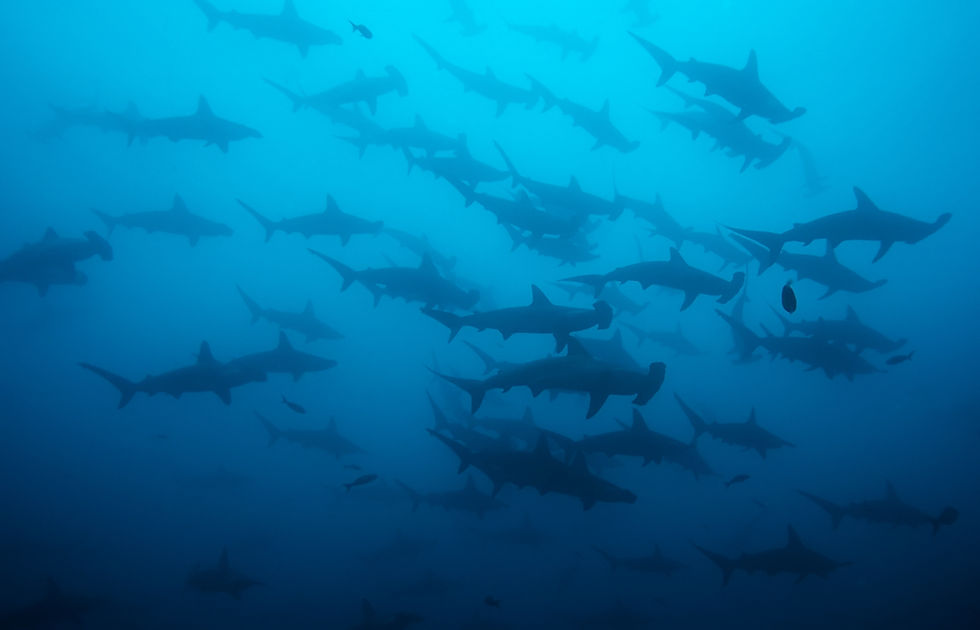
Why hammerhead sharks gather at Gordo Banks
The sharks at Gordo Banks are scalloped hammerheads (Sphyrna lewini). They can grow to more than 10 ft (3 m), and they are known for something few sharks do: they school.
Hammerheads feed at night in deep water. During the day they come back to seamounts to rest in the current and to be cleaned by reef fish. That daytime habit is what puts them within a diver's reach.
They are also critically endangered. Divers who knew the Sea of Cortez in the 1970s describe schools of a hundred sharks or more on its seamounts, and a study published in 2024 found that at two of them those numbers have collapsed. Gordo Banks is one of the places where you can still see them, which is one more reason to dive it with care.
When is the best time to dive Gordo Banks?
August to January is the best season: the water is at its warmest and visibility is at its best.
Months | What to expect |
August to November | Warm water and the best visibility of the year. Silky sharks are regular, often at the safety stop. |
December and January | Still good for hammerheads. The water starts to cool. Humpback whales are in the area: you often hear them underwater, and now and then one passes by. We never look for them or approach them. |
February to July | Possible on the right day, but currents are stronger and thermoclines are colder. We cancel more often. |
Whatever the month, the water changes on the way down. It can be warm at the surface and noticeably colder below the thermocline, around 100 ft (30 m). That is why we dive it in a 5 mm or 7 mm wetsuit.

What the dive is like
There is no reef to follow and no bottom in sight. Most days it is a free descent with no line: the whole group goes down together through blue water, watching depth gauges, because without a wall next to you it is easy to go deeper than planned without noticing.
Around 100 ft (30 m) the top of the seamount starts to appear, usually covered in fish. We stay there and look out into the blue, because that is where the hammerheads come from. Bottom time is short: at this depth, on air, you have about 20 minutes before reaching the no-decompression limit.
The ascent is part of the dive. Silky sharks, mobula rays and sometimes marlin or tuna pass at mid-depth and at the safety stop, so keep looking around until you are on the boat.
We do two dives, and the trip takes about 6 hours in total.
How to behave around hammerheads
Hammerheads are shy. Noise and bubbles push them away, so the divers who see them best are the ones who do the least: stay level, breathe slowly, and don't swim toward them. If the school comes in, let it. One diver chasing a shark ends the encounter for the whole group.
Who can dive Gordo Banks? The requirements
We ask for three things, and none of them is flexible:
Advanced Open Water certification or equivalent. The seamount is below the 60 ft (18 m) limit of an Open Water diver. If you are not there yet, you can take the PADI Advanced Open Water course with us in two half days.
At least 40 logged dives. You need buoyancy, air management and awareness of the group to be automatic.
A check dive with us beforehand. Everyone does it, including instructors.
You also need to be at least 18.
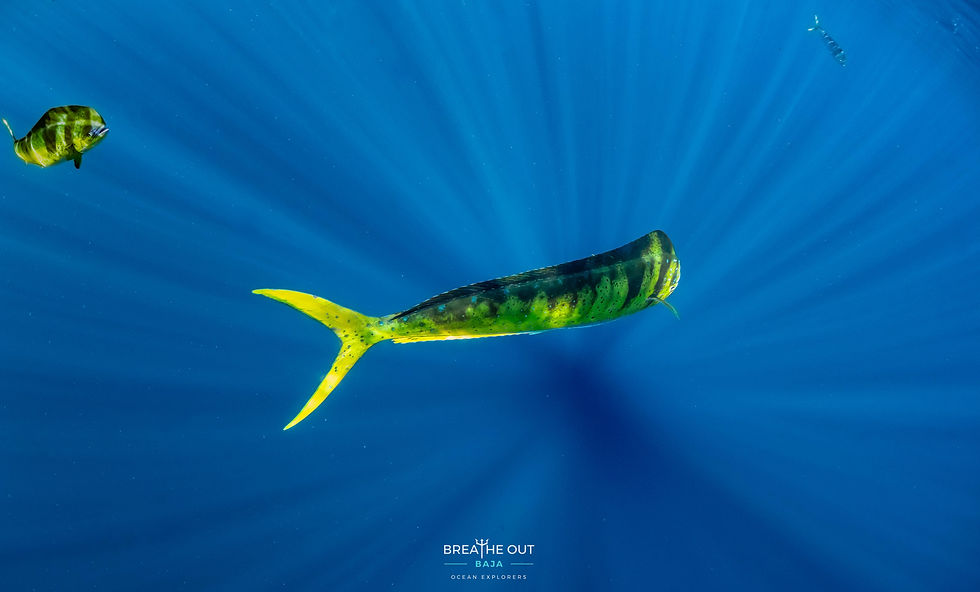
Why everyone does a check dive
At Gordo Banks there is no shallow area to fix a problem. If you are overweighted, underweighted or uncomfortable, you find out at depth, in a current, with nothing around you.
So before the trip we do a dive in the Cabo San Lucas Marine Park together. We adjust your weights for a thicker wetsuit (the Sea of Cortez is saltier than most seas, so you will probably need more lead than you expect), check your gear, and see how much air you use. If it has been a while since your last dive, a scuba refresher first is a good idea.
How we keep the dive safe
The risk at Gordo Banks is not the sharks. It is the open ocean. In 2012, a group of divers surfaced here after a drift dive, could not be found by their boat, and spent about 14 hours adrift before swimming to shore. Everything we carry is meant to make sure that cannot happen to you.
Small groups, so the guide can watch every diver's depth and air.
A surface marker buoy for each diver, to mark your position at the safety stop and at the surface.
A marine rescue beacon with each guide. If a team surfaces away from the boat, it sends its GPS position to the boat's radio and to other vessels nearby.
A satellite communicator on board, so we can call for help with no phone signal.
Do you need Nitrox?
It is not mandatory, but we strongly recommend it. On air, your time at the top of the seamount is counted in minutes. Enriched air gives you more bottom time within the same limits, and most divers feel less tired after two deep dives.
If you are not certified, the PADI Nitrox course is short and you can do it before the trip.
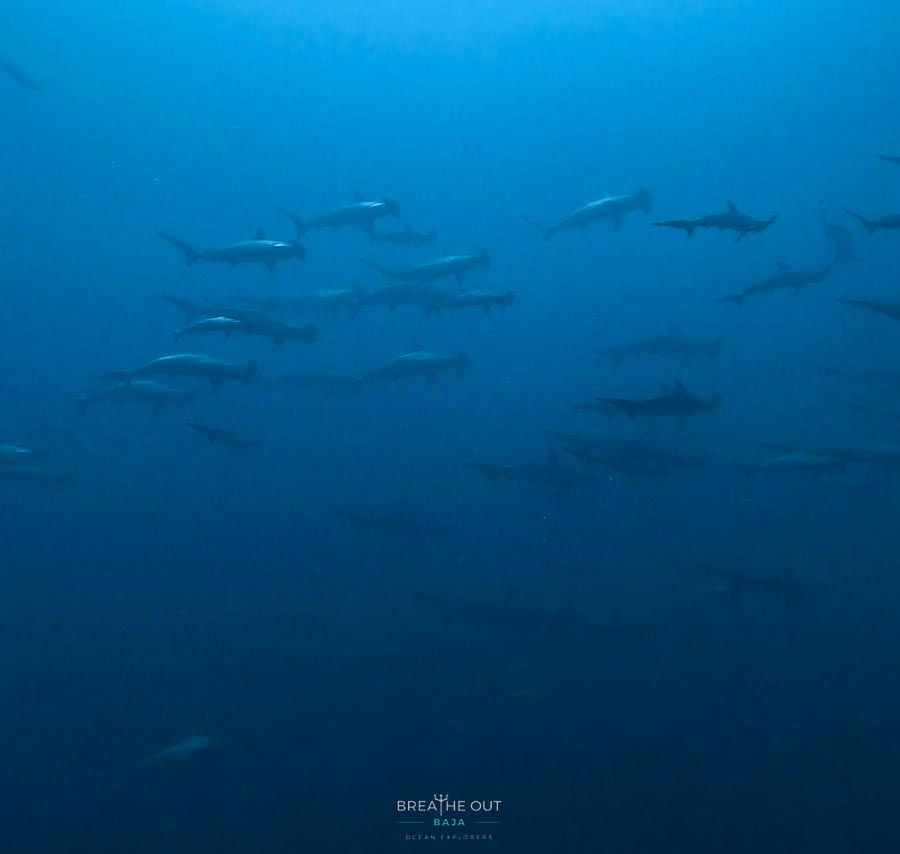
The honest part: it is a hit or miss dive
Nobody feeds or baits the sharks at Gordo Banks. Whether they are there depends on current, water temperature and the moon, and some days they are simply deeper than we can go.
On a good day you see hammerheads, silkies, a wall of jacks and maybe a marlin. On a quiet day you get a deep blue-water dive on a seamount full of fish. Come for the dive itself, and treat the hammerheads as what they are: a wild animal that sometimes shows up.
Quick answers about scuba diving in Gordo Banks
Can Open Water divers go to Gordo Banks?
No. You need Advanced Open Water and 40 logged dives. For Open Water divers we have other sites in Cabo, and the Advanced course is the way to get here.
How deep is the dive at Gordo Banks?
The top of the inner bank is at about 115 ft (35 m). The exact depth each day depends on where the fish and the sharks are.
Are hammerhead sharks dangerous to divers?
Scalloped hammerheads are timid and keep their distance. The difficult part is getting close to them, not keeping away.
Do you always see hammerheads?
No, and nobody can promise it. August to January gives you the best chance.
How long is the trip?
About 6 hours, with two dives. We leave early from the Cabo San Lucas marina. If you get seasick, take your tablet before boarding.
What should I bring?
Your certification card and logbook, a swimsuit, sunglasses, a hat and a sweater for the ride. Our scuba diving packing list for Cabo has the rest.

Ready for Gordo Banks?
If you have your Advanced certification and 40 dives, write to us and we will plan your check dive and your trip to Gordo Banks. If you are not there yet, tell us where you are and we will help you get ready.


Comments